Fiction design workshops

Anticipating the future rather than enduring it

Project your company into possible futures with our design fiction workshops.
Imagine, test and adapt to tomorrow's challenges before they even happen.

We projected them into the future

Vinci logo
670e6dae92e6dab5db99fbec Agirc Arrco logo
Kering workshop atelier
670e6dae339ed219d3a58825 Ayvens logo
670e6dae244fae7c3bf15090 Lesaffre logo
EVERYTHING TO KNOW

What is design fiction?

From science fiction to design fiction

Initially theorized by Julian Bleecker, co-founder of the Near Future Laboratory, design fiction has its roots in science fiction and futures studies.

Design fiction is a form of design that draws on stories imagining possible futures to generate ideas and question actions to be taken in the present.

By transforming hypotheses about the future into immersive scenarios, this discipline enables organizations to project themselves into future environments(Speculative Everything Design, Fiction, and Social Dreaming, MIT Press) in an immersive and empathetic way. In this way, itshakes up the status quo and questions our norms, ethics and values.
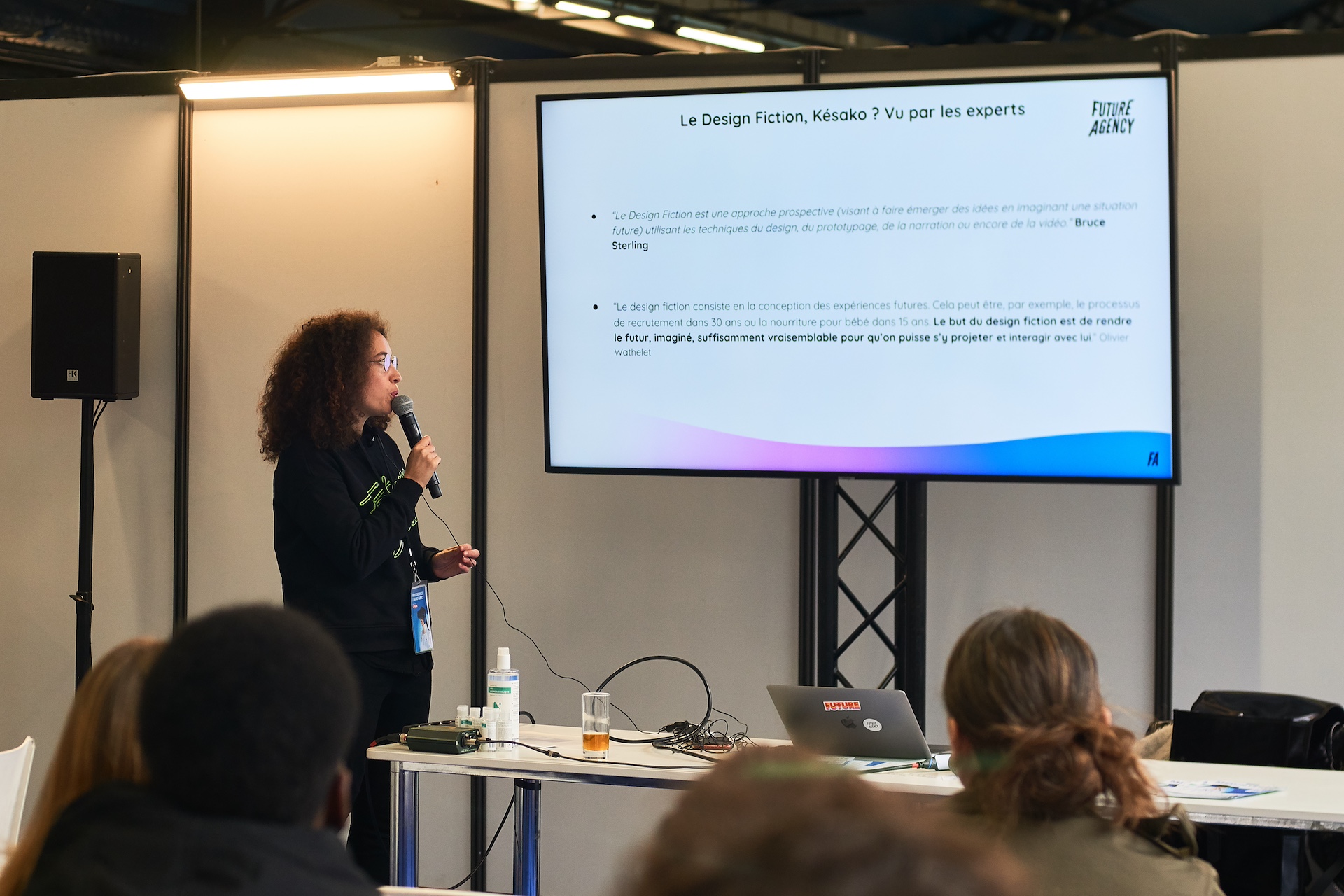
Atelier design fiction Léa

Using design fiction for business innovation

Design fiction is a strategic tool for business innovation. By visualizing possible futures, teams can identify new opportunities, test ideas without risk, and strengthen their ability to adapt.

The principle of a design fiction workshop is to imagine, with the help of a facilitator, scenarios, postures and services that could see the light of day according to the possible futures that will have been explored.

Today, leaders such as IKEA, Google and Microsoft use design fiction to anticipate innovations and changes in their sector.
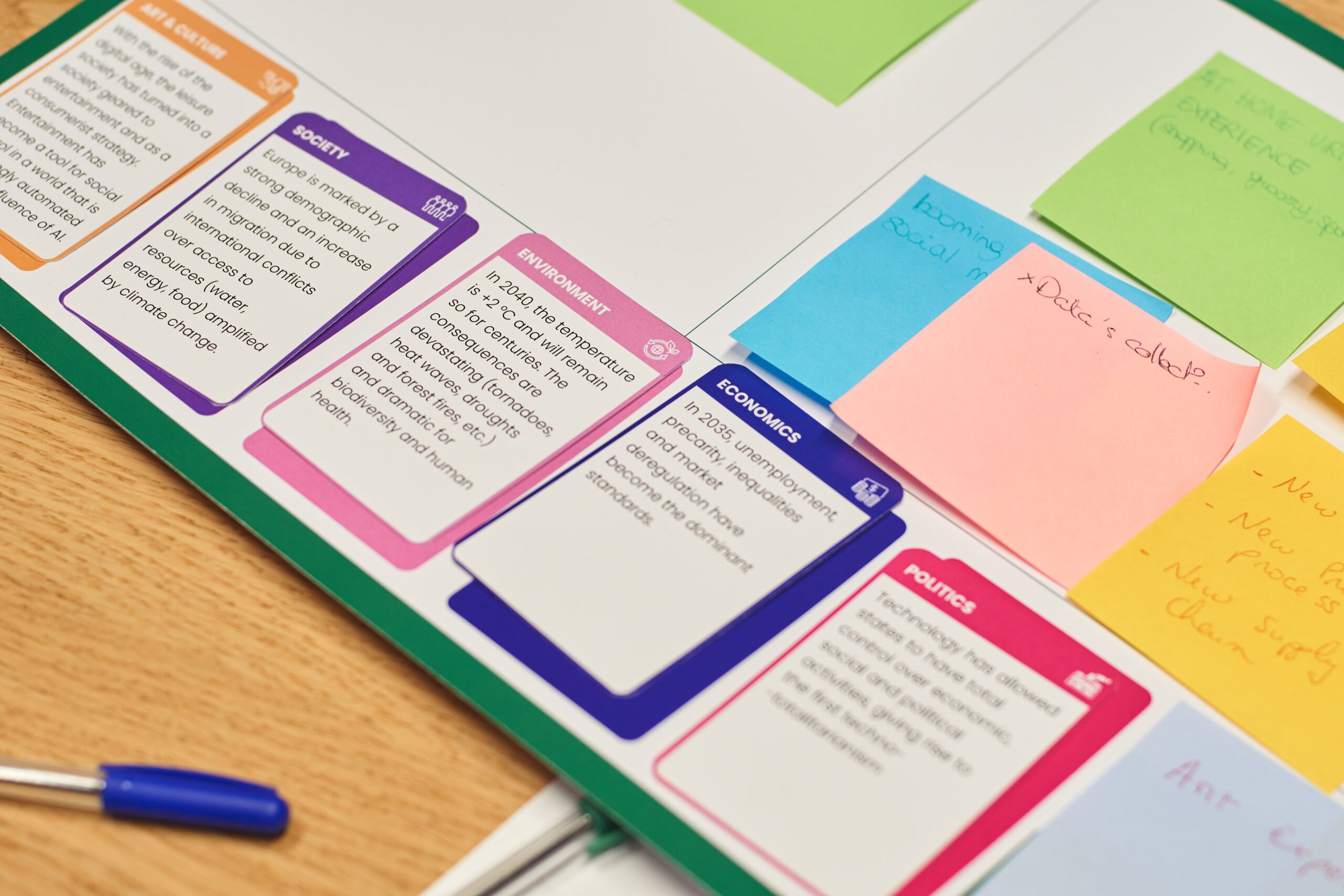
Kering atelier design fiction plateau de jeu

Why organize a design fiction workshop?

Anticipate future market disruptions

Use future scenarios to build strategic advantage.

Accelerate innovation and intrapreneurship

Transform hypotheses into concrete actions and disruptive projects.

Strengthen your organization's resilience and agility

Prepare your organization for crises and unexpected changes.

Align your teams around a shared vision

Get your teams on board with clear, motivating future objectives.

Make informed decisions to anticipate the future

Test and adjust your strategic decisions according to possible futures.

Inspire an open, proactive innovation culture

Question the status quo and explore new ideas for the future.

Would you like to organize a fiction design workshop?

OUR EXPERTISE

How does a design fiction workshop work?

Since 2019, we've been facilitating design fiction workshops for our customers to help them project themselves into the future of their industry or business and help them anticipate upcoming transformations.

Discover our case study "Kering: imagining the conscious retail of the future thanks to design fiction"

Download our design fiction workshop brochure
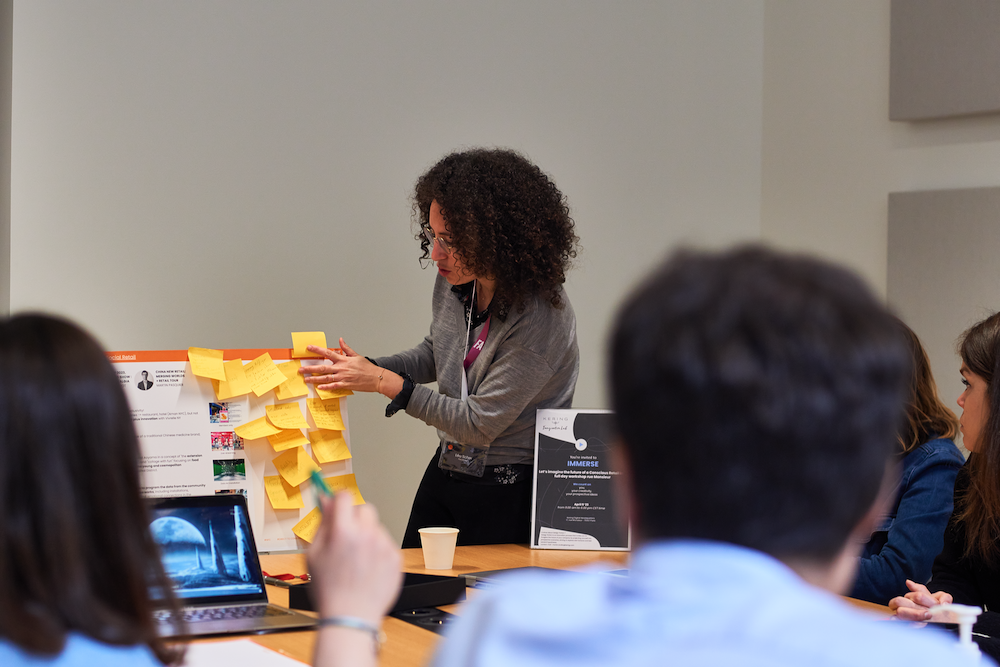
Kering x Future Agency organization workshop

The aim of a design fiction workshop is to generate ideas by imagining a future situation and using the techniques of design, prototyping, storytelling and video to create artifacts.
from 1h30
to 1 day

10 - 50
people

face-to-face
or online

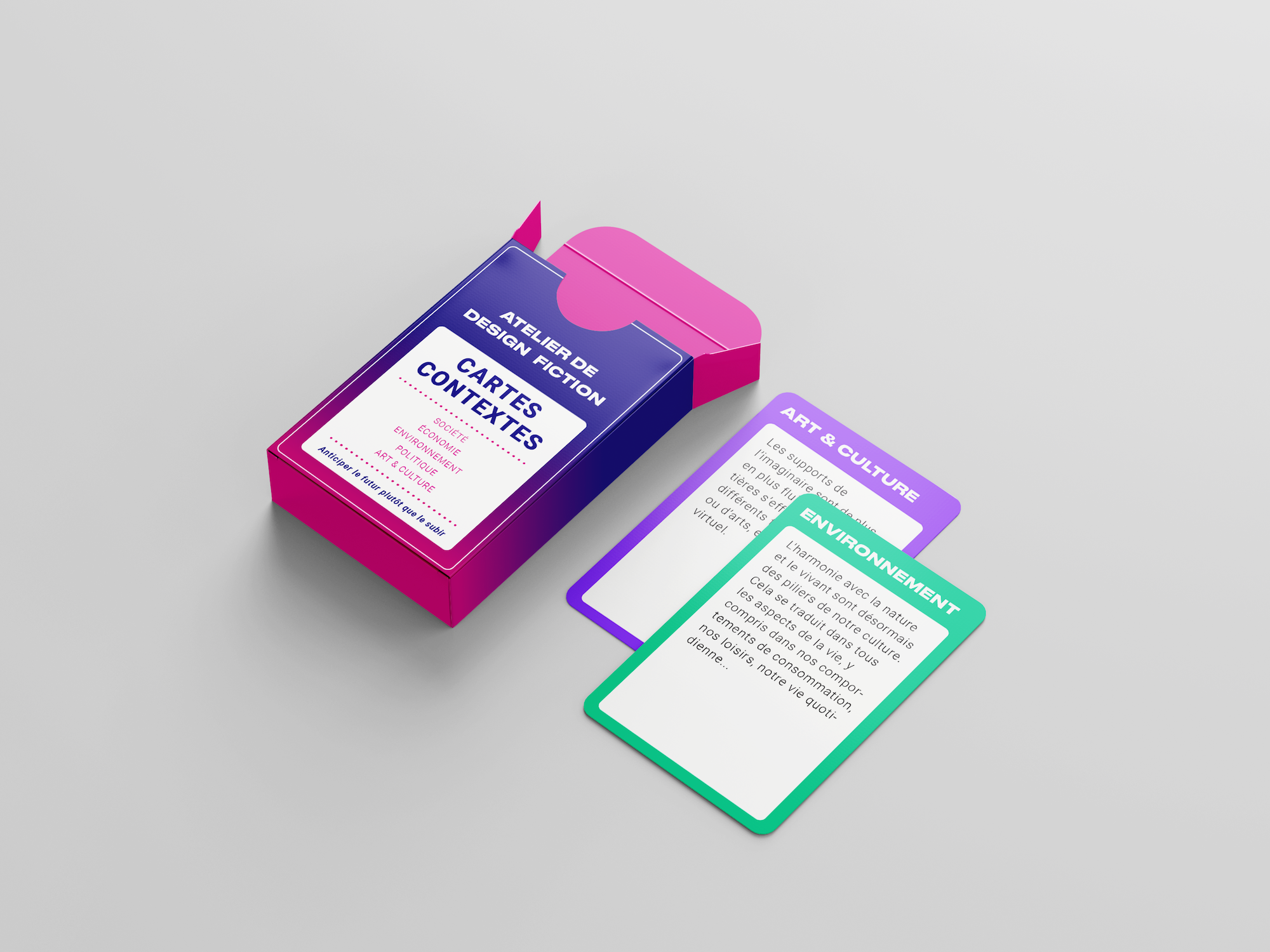
Cards design fiction workshop

‍The method follows 4 immersive, creative stages supported by tools and deliverables.

1

Analysis

of the present, trends and weak signals to frame the issues at stake

Deliverable: mapping of weak signals

2

Immersion

in prospective scenarios for 2030, 2040 and 2050 based on context maps

Tools: game board and deck of cards

3

Creation

concrete artifacts to materialize your team's response to scenarios

Deliverables: objects, stories or solution prototypes

4

Convergence

by pooling ideas and defining a roadmap

Deliverable: roadmap and operational milestones

EXAMPLES

Who is design fiction for?

COMEX

Develop a vision to embark your company on a transformation plan.

Example: Designing new data modeling tools for an insurance company to better respond to weather-related claims

Innovation

Understand the impact of new technologies on your business and your sector.

Example: Building new supply chains and developing alternative sourcing strategies for a food giant

Transformation

Create a strategic transformation plan based on insights and weak signals.

Example: Building a new business model for a vehicle leasing company to meet new needs.

CSR

Anticipate new regulations and respond to ecological and societal challenges.

Example: Transforming the sourcing and production methods of a luxury goods company to make it a player in the ecological transition.

RH

Helping leaders and talents develop a strategic posture and vision.

Example: Imagine the healthcare professions of tomorrow to anticipate recruitment and training needs for a pharmaceutical company.

Communication

Project a team into the future at a seminar or convention.

Example: Rethinking the hotel industry to respond to the rise of airless tourism and the adoption of the new "slow living" lifestyle.

WHAT WE CAN DO FOR YOU

4 fiction design workshop formats

Discovery

3 500€

Learn about design fiction by exploring its history and carrying out practical exercises. Discover the basics of this method and develop a new way of imagining tomorrow's possibilities.

1h30
10-50 participants
in person or by video
deliverable: mapping of weak signals

Exploration

6 000€ - 8 000€

Go deeper into design fiction with a theoretical introduction and targeted application. Our experts will guide you in formulating and solving a problem adapted to your needs.

4h
10-50 participants
in person or by video
deliverables: mapping of weak signals, notebook of possible futures

Immersion

10 000€ - 15 000€

Dive into the heart of design fiction with advanced hands-on practice and create an artifact. With the help of our experts, you'll formulate a strategic problem and develop a concrete roadmap.

1 day
10-30 participants
face-to-face
deliverables: mapping of weak signals, notebook of possible futures, artifacts & roadmap

Tailor-made

prices on request

Co-create a design fiction workshop perfectly tailored to your objectives. In collaboration with our experts, we build a workshop with customized exercises to meet your challenges.

we adapt to your brief!
CONTACT

Need more information?

Would you like to organize a design fiction workshop?
Tell us what you have in mind, and our team will get back to you.

Read more

In the corporate world,design fiction is mainly used to stimulate innovation. Without making predictions, this creative method allows us to ask ourselves what we want tomorrow's company to look like, and to question the decisions we need to make today.

This innovation process may be firmly rooted in the future, but its objective is to act and reinforce corporate strategy in the present. This forward-thinking process must be translated into concrete action to solve problems, structure new innovative projects and, ultimately, maintain a company's competitiveness. Discover our methodologies.

As a means of creating debate and speculation, design fiction is increasingly used by companies today, as it is a real tool for projecting, experimenting, making decisions and implementing actions. 

This technique enables an innovative company toimagine possible futures and their consequences, toexplore the implications of new technologies or social changes, always looking at the weak signals already observable in the present.

In concrete terms, design fiction can answer a number of questions, such as:

  • Is it possible to identify a new technology, a social phenomenon or an innovative idea that will transform the market in the medium to long term - in other words, a current weak signal?
  • What would our society look like if this change were to take place?
  • What needs might this development bring?
  • How can the company adapt and renew itself to meet these new needs?

This forward-looking vision makes it easier to anticipate future needs. Any company, whatever its size or sector of activity, can use design fiction to project itself and generate ideas: new technologies, health and safety, engineering, leisure and creativity, culture, tourism, digital start-ups, local authorities, etc.

This collaborative innovation strategy has several advantages:

  • Design fiction allows us toenvisage different scenarios, and not limit ourselves to a single possibility. It widens the field of possibilities and anticipates several possible futures.
  • Forward-looking scenarios enable us toapproach issues and problems from a new angle. Freed from the usual constraints of strategic thinking, employees are more creative.
  • By boosting the imagination, this innovative exercise allows us toexplore new avenues, develop new ideas and generate action.
  • Design fiction helps to ask the right questions and unlock potential resistance to change. It's a tool for brainstorming and debate, for questioning the present, imagining and building the future.
  • Using storytelling elements, this approach makes imagined situations real and moving enough to generate productive debate.
  • It's a collaborative approach that uses collective intelligence to support the transformation of companies and their employees.
  • With its longer-term focus, it is a complementary tool to design thinking.

To reap the full benefits of a design fiction project, it's best to define a future that's sufficiently close for participants to be able to project themselves easily. It's also important to bear in mind that this method is human-centered, and that its aim is always to innovate in the service of people.

Design fiction can be a powerful tool for innovation. But it's important to realize that this creative thinking is in no way intended to provide an exact forecast of the future. To assert otherwise could be counter-productive.

Fiction is, by definition, a subjective construction. The way we look at a subject or an issue is rarely neutral. As a result, the fictional framework proposed collectively will inevitably be influenced by everyone's experience, point of view and values. The innovation process must therefore always be based on concrete elements, on weak signals observed in the present that could potentially develop in the medium and long term.

Discover our other workshops.

Design fiction is often proposed in the form of a workshop or speculative debate, in a participative and collective way. The process can vary from one workshop to another, depending on the needs and subjects addressed, but in general it's necessary to establish a framework for reflection before calling on the imagination and moving on to the ideation phase. Indeed, design fiction puts creativity and imagination to the fore, going beyond probabilities and trying to draw possible futures, but the methodology must remain pragmatic.

To experiment with these possible futures and envisage the present differently, several levers are used in design fiction, such as backcasting, prototyping new ideas and so on. A design fiction workshop generally ends with the creation of one or more prototypes, whose viability within the imagined market needs to be analyzed.

These prototypes can take a variety of forms: digital applications, films, video games, paper models, etc. They must materialize a situation, tackle complex issues while remaining realistic, since their technical feasibility, economic model, etc. must then be the subject of a study and strategic analysis.

A design fiction project can be completed in a few hours or over one or two days, depending on the objectives set.

Would you like to organize a design fiction workshop to imagine your futuristic fictions, and create debate and discussion in your teams? Contact us here!